We design and operate neighborhoods as integrated systems. Walkable, regenerative, and built to improve with time, not depreciate against it.
The Stack · The Process · Ten guiding principles
A discipline of integration
Urbanism, not just development.
Our approach is grounded in the urbanist tradition (walkability, human scale, mixed use, public space) and extended with systems thinking, regenerative design, and integrated capital. The goal is not just to build well. The goal is to build places that keep getting better.
Most real estate work treats a project as a set of parallel concerns. Buildings on one track, infrastructure on another, public realm on a third, finance on a fourth. Each gets optimized in isolation, sometimes in tension with the others.
Urbanism is the discipline of integrating those concerns into a single coherent place. Streets, blocks, buildings, landscape, mobility, energy, water, governance, and culture, all designed together so the whole performs better than the sum of its parts.
First principle
The land and the systems determine the plan.
Most development inverts this. A pro forma sets a unit count or a square-footage target, designers reverse-engineer a building program to fit, and engineering follows once the shape is locked.
We start the other way. Hydrology, ecology, climate, microclimate, soil, mobility patterns, and existing community fabric tell us what the site can carry and what it wants to become. Systems analysis tells us how energy, water, materials, and movement should flow.
From those findings, the plan emerges. The pro forma is built once the systems are designed, not before.
This sequence costs more in pre-development time. It pays for itself many times over in entitlement speed, engineering cost, infrastructure efficiency, community alignment, and long-term operating performance.
It is also why we exist. Most development teams cannot afford to do this rigorously. We are organized around it.
The Stack
Four layers, designed together.
The Now City Stack is four delivery layers we coordinate as one system. Each is a discipline. Together they produce better neighborhoods at lower lifecycle cost.
Industrialized construction
Build better, faster, with less waste.
Off-site fabrication, kit-of-parts assembly, mass timber and other healthy materials. We coordinate factory and site from day one to compress schedules, reduce embodied carbon, and improve build quality. The neighborhood becomes a system that can be assembled, not a project to be improvised on a job site.
Green infrastructure
Energy, water, mobility, ecology.
District-scale systems for power, heating and cooling, water and stormwater, mobility, and natural infrastructure. Sized at the right scale, these systems lower capex per unit, reduce opex, and produce resilience as a byproduct. Landscape is treated as performing infrastructure, not decoration.
Regenerative placemaking
Streets, public realm, and the daily routine.
Walkable streets, civic gathering, ground-floor activation, local economic development, and community programming. Designed to make daily life delightful and to support small, place-rooted business. Places people want to be, not just places they have to live.
Innovative finance
Capital aligned with stewardship.
Capital structures designed for long-term ownership and shared value, not short-term exit. Mixed-income housing financed on a level that pencils. Public-private partnerships structured so cities, residents, operators, and investors share risk and upside in patient proportion.
Neighborhood as the unit
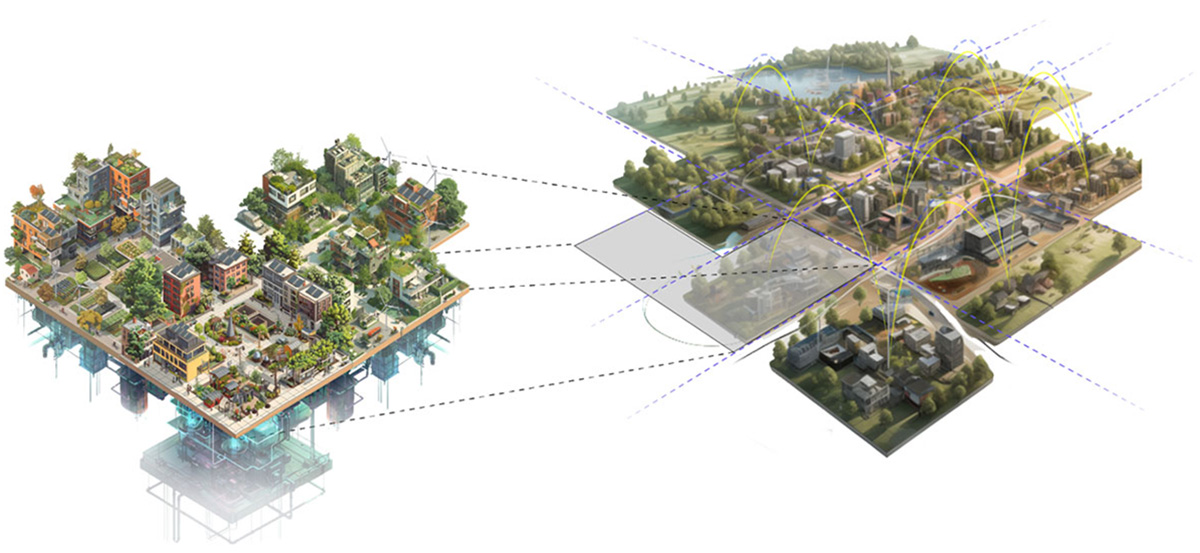
One neighborhood is a system. A network of neighborhoods is a city.
We design at the neighborhood scale (roughly 1,000 to 10,000 people) because it is the smallest unit at which walkability, community, ecology, and infrastructure can all work together. It is also the largest unit one team can hold coherently in mind.
Done well, each neighborhood is a building block in a broader regional system. Connected, distributed, and resilient by design.
Conceptual diagram. The neighborhood as an integrated unit, networked into a regional system.
The Process
From land to long-term stewardship.
Our engagement framework runs in four phases. Each is a discrete body of work with its own deliverables. The sequence matters.
01Carrying capacity
→
02Systems & program
→
03Pro forma & capital
→
04Execution & stewardship
Phase 01
Carrying capacity and opportunity discovery.
Site analysis. Hydrology, ecology, climate, soils, mobility, fabric, and policy. What the land can carry and what it wants to become.
Phase 02
Systems and program synergy design.
Coordinated design of energy, water, mobility, ecology, and program. The systems and the use mix shape each other, simultaneously.
Phase 03
Pro forma and capital structuring.
The pro forma is built around the system, not before it. Capital is sourced and structured to match the long-term stewardship model.
Phase 04
Execution and stewardship.
Construction, lease-up, and operations. Continuous improvement informed by data and resident feedback. Stewardship is the longest phase, by design.
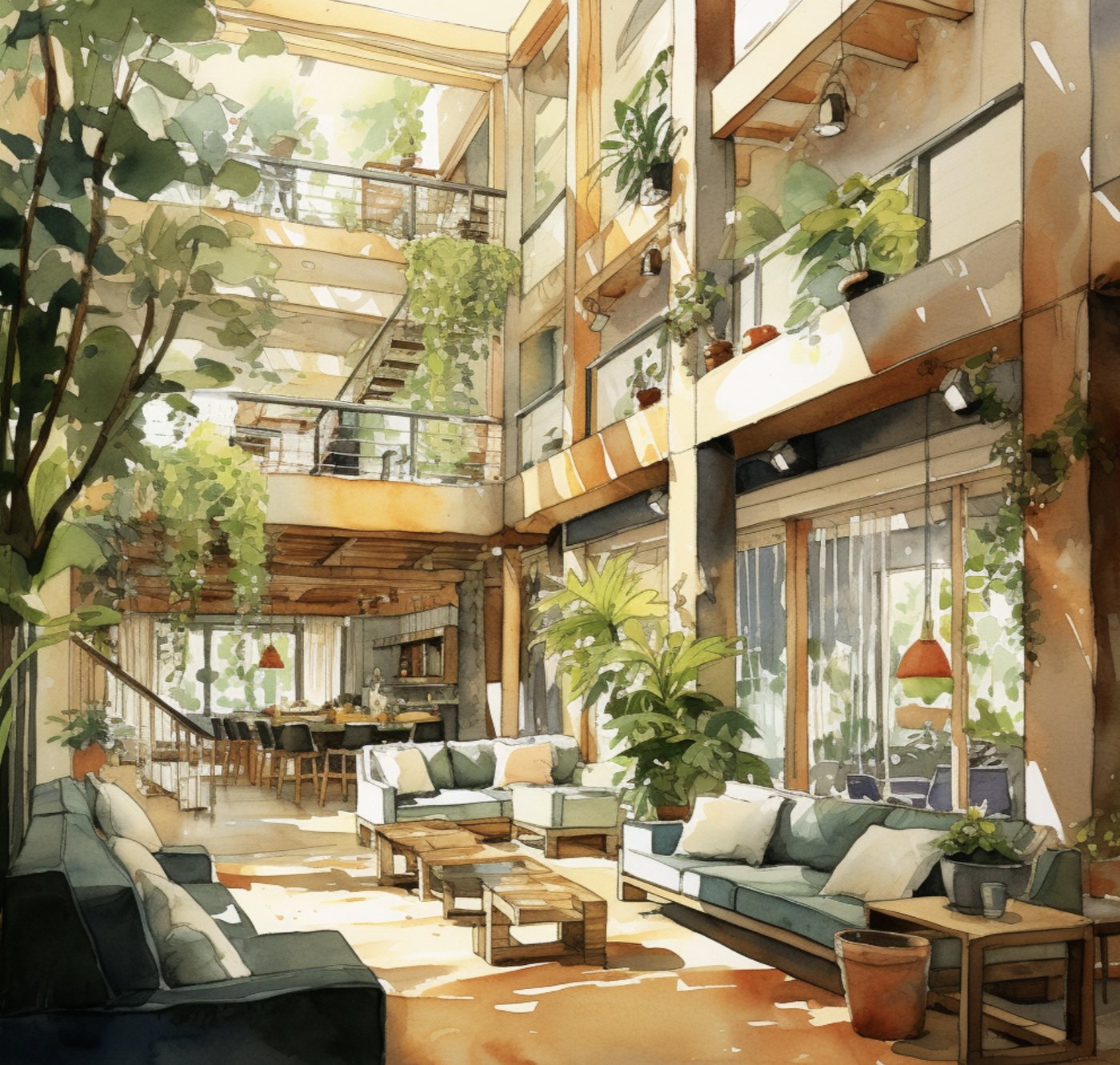
All of this integration is in service of one thing: places that feel like home, where everyday life is easy and people want to stay. Concept rendering.
Ten guiding principles
The principles behind every project.
Our design framework has ten principles that translate the stack into site-specific decisions. Each is a question we ask of every site, every block, every building.
Place-Based
Every site is a one-of-one. Rigorous site analysis on hydrology, ecology, climate, microclimate, soil, mobility, and existing community fabric shapes the plan. The site speaks first.
Compact
Walkable density unlocks the rest. We design for the 15-minute neighborhood, with daily needs reachable on foot. Compactness is what makes ecology, mobility, and economy work together.
People-Centric
Streets designed for people first, vehicles second. Active mobility, traffic-calmed corridors, and a public realm structured around the pedestrian experience.
Healthy Environment
Daily exposure to nature, clean air, natural light, and quiet. Biophilic streetscapes, abundant green space, and food access designed in. Health is an urbanism output, not an amenity.
Decentralized Systems
Energy, water, food, and mobility produced and managed at the district scale. Lower lifecycle cost, lower carbon, and meaningful resilience when central systems falter.
Circular Economy
Reduce, reuse, regenerate. Healthy materials specified for end-of-life recovery. Waste, water, and nutrient flows designed as loops, not streams to be dumped.
Ecologically Rooted
Landscape as living infrastructure. Stormwater management, biodiversity, urban canopy, and habitat restoration designed alongside buildings, never as an afterthought.
Adaptive by Design
Buildings and public space that flex with changing needs over decades. Modular structure, reconfigurable layouts, and flexible programming. Built to evolve, not to depreciate.
Successful Feedback Loops
Community input at every stage, before and after construction. Operations data once stabilized. Continuous improvement, not one-time delivery.
Innovative Finance
Capital structured for long-term stewardship and mixed-income housing. Aligned ownership across residents, operators, and investors. Finance as a design discipline.
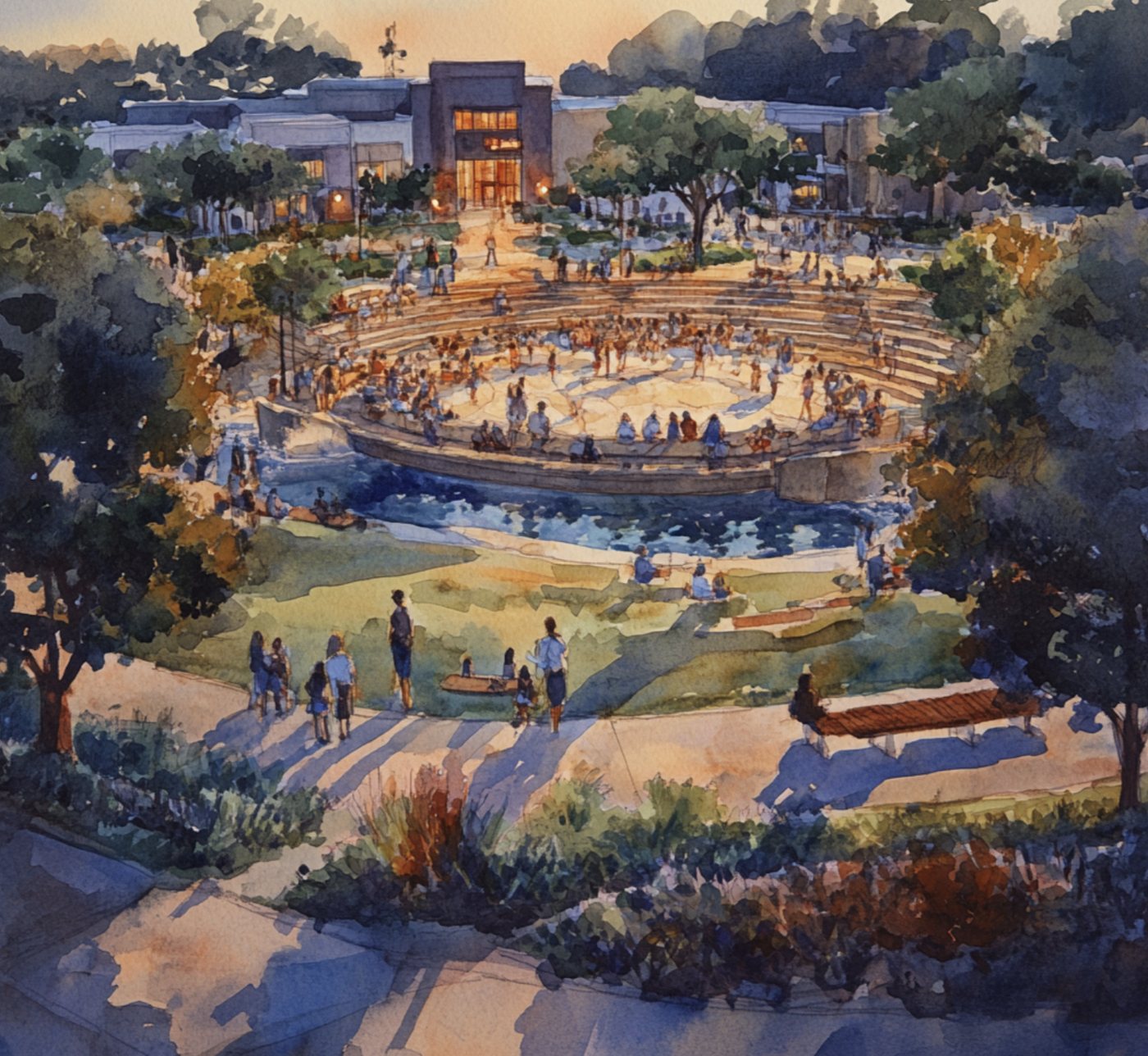
Shared space is where a neighborhood becomes a community: a commons that belongs to everyone who lives here. Concept rendering.
Why it matters
Outcomes that compound.
Walkable, mixed-use, regenerative neighborhoods perform better on the metrics that matter to cities, residents, and capital. The body of urbanism research is clear, and decades of comparable projects bear it out.
Our model is built to do well across these dimensions from day one, then keep getting better through stewardship.
Mobility
Lower vehicle miles traveled, shorter commutes, more trips by foot and bike.
Carbon
Lower embodied and operational carbon. District energy and biophilic infrastructure compound the savings.
Health
Higher daily activity, lower air pollution exposure, better mental health from green space and social connection.
Economy
Stronger small-business survival rates, deeper local spending, more diversified tax base for cities.
Resilience
Decentralized infrastructure performs in emergencies. Lower insurance risk profile over time.
Property value
Walkable, well-programmed urbanism trades at a durable premium. The premium tends to grow with neighborhood maturity.
Work with us
If you steward a site, a city, or capital that wants to build this way, talk to us.
For landowners and operators
Our services arm offers the approach described above as a hands-on engagement, start to finish.
Our services arm provides the capacity-building, feasibility, and partnership-structuring support that cities and landowners need before a deal exists, the early-stage work that municipalities often cannot resource alone.
If any of this resonates, we would love to hear from you, whether you are an investor, a landowner, a city, a future resident, or simply curious. No commitment, just the start of a conversation.